


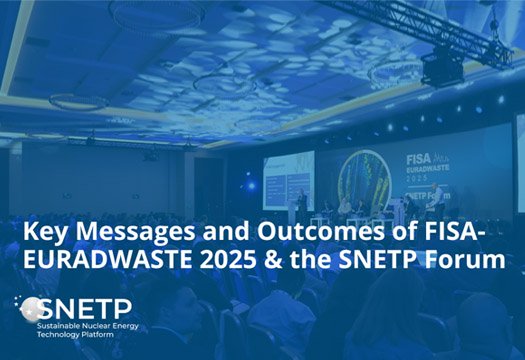
The Key Messages and Outcomes Report summarising the FISA-EURADWASTE 2025 & SNETP Forum is now available. The joint conference took place from 12 to 16 May 2025 in Warsaw, Poland.
This large-scale event brought together three key thematic strands:
- FISA – the conference on the safety of reactor systems involving fission;
- EURADWASTE – the conference on radioactive waste management;
- SNETP Forum – the platform for discussions on innovation in sustainable nuclear energy.
The event was held under the Polish Presidency of the Council of the European Union, in cooperation with the National Centre for Nuclear Research (NCBJ), the Sustainable Nuclear Energy Technology Platform (SNETP), the European Nuclear Education Network (ENEN), the European Nuclear Society (ENS), and the Young Generation Network of the ENS (ENS-YGN).
The conference brought together stakeholders from across the nuclear sector to discuss the role of research and innovation in shaping Europe’s energy future. It reaffirmed the strategic importance of nuclear energy in delivering the EU’s climate, industrial and energy objectives. The discussions focused on decarbonisation, energy sovereignty, and technological competitiveness.
Key highlights and outcomes:
🔹 Nuclear energy as a pillar of the EU’s climate strategy
In the context of the EU’s target to reduce greenhouse gas emissions by 90% by 2040, nuclear energy is recognised as an essential component in achieving climate neutrality by 2050.
🔹 Ensuring energy security
The reliability and stability of electricity supply provided by nuclear power remain crucial to the EU’s energy policy.
🔹 Innovation and emerging technologies
Participants discussed pathways for the development of Small Modular Reactors (SMRs), fusion energy, and other advanced technologies. The need to maintain Europe’s leadership in nuclear research and development was strongly emphasised.
🔹 Reviving momentum for new nuclear builds
Key lessons from recent large-scale projects highlighted the importance of standardisation, modular construction, supply chain integration, workforce development, and technical alignment across the EU.
🔹 Strategic autonomy and closed fuel cycles
Europe needs to develop both near-term solutions (such as ATF, MOX, and HALEU) and breakthrough innovations, including fast reactors, multi-recycling, and advanced materials.
🔹 Non-electric applications
Nuclear energy has strong potential in hydrogen production, industrial heat supply, and district heating. SMRs and HTGRs are seen as key technologies for decarbonising hard-to-abate sectors.
🔹 Youth engagement and societal dialogue
18% of participants were early-career professionals. Discussions also addressed the ethical and societal dimensions of nuclear energy development.
🔹 Cross-sector innovation and integration
The forum highlighted the increasing importance of digitalisation, artificial intelligence, and other high-tech solutions for improving the safety and sustainability of nuclear energy.
🔹 Support from key institutions
The European Commission, the European Investment Bank, and the World Bank reaffirmed their commitment to supporting nuclear energy within the broader context of decarbonisation and energy security.
🔹 Research infrastructure and international cooperation
The forum underlined the importance of open-access research facilities, cross-border data sharing, and long-term investment in pan-European infrastructure, alongside collaboration with international partners.
The Summary Report serves as a valuable resource for stakeholders across the nuclear field and will help foster continued collaboration in research and innovation.
The full report is available at: Key Messages and Outcomes Report


