


With the rapid development of ambitious space programmes, the topic of radiation protection has become increasingly relevant. Future missions to the Moon or Mars involve extended human presence in outer space, where levels of ionising radiation far exceed those on Earth. We invite students, researchers, and professionals to join the free online course “Radiation Protection Research for Space Applications”, dedicated to exploring radiation protection strategies in space missions.
This educational course delves into key aspects of radiation protection for space travel, including the unique spectrum of space radiation, its biological effects on humans and materials, and shielding strategies to protect astronauts and spacecraft from radiation-induced damage.
Participants will gain a solid understanding of the space radiation environment, techniques for its measurement, biological effects, and mitigation approaches.
Topics covered in the course include:
- the spectrum of ionising radiation in space;
- effects of radiation on human health and materials;
- measurement methods, dosimetry, and protective systems;
- risk minimisation strategies and medical countermeasures;
- ground-based research approaches using space analogues.
Lecturers include leading experts from ESA, Stanford University, DLR, BIRA-IASB, UHasselt, Ghent University, Magics, and other scientific institutions.
The course is particularly suitable for master’s and PhD students, early-career researchers, and professionals from various fields—biomedicine, physics, engineering, health sciences—who are interested in radiation safety in space. It also provides an excellent opportunity to network with space research experts and representatives of institutions and companies engaged in space-related applications.
Participation is free of charge but limited to 25 selected participants. Applications must be submitted by 14 September 2025. To apply, send a single PDF file to academy@sckcen.be, including your contact details, a short motivation statement (up to 200 words), and your scientific CV with your current role and research area.
🔗 More information and registration: https://lnkd.in/eb82wdJB
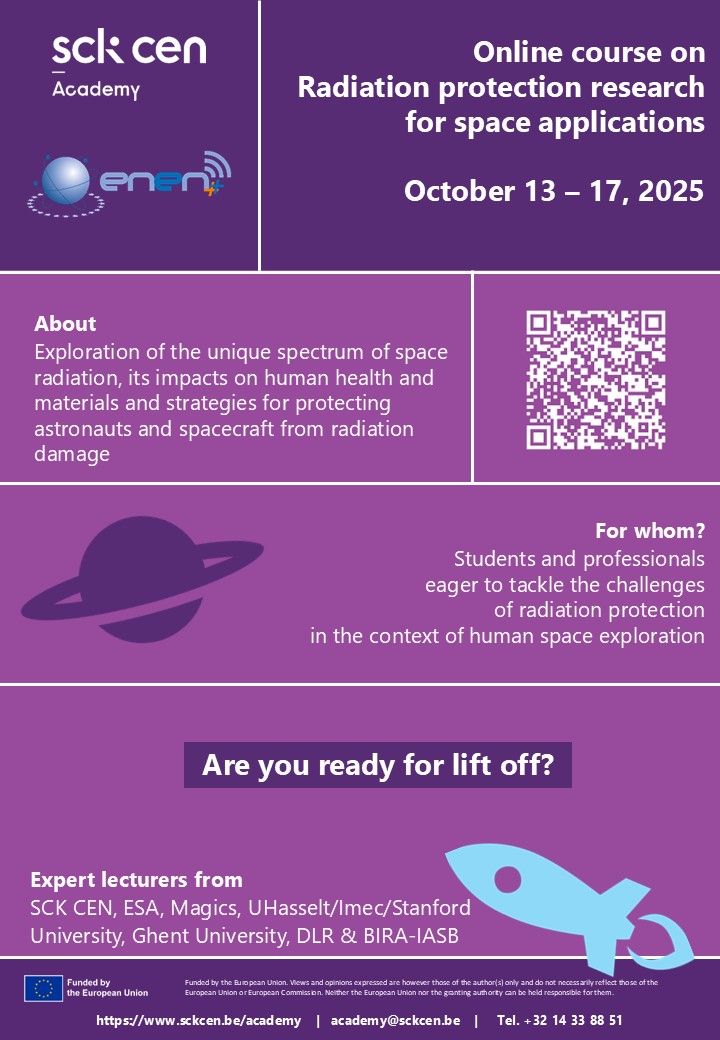
The course is organised under the ENEN2plus project with the support of the European Union. The views expressed are those of the authors and do not necessarily reflect the official position of the EU or the European Commission.


