


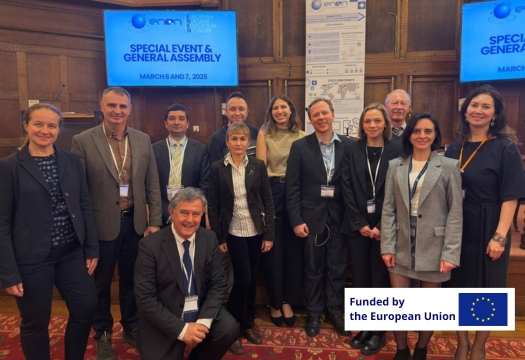
On March 6, 2025, the NURECAB project working meeting took place in Brussels, Belgium, as part of the two-day program of the European Nuclear Education Network (ENEN). This event marked an important milestone in expanding Ukraine’s international cooperation in nuclear education and research, opening new opportunities for integration into the European scientific community.
Holding the event under the auspices of ENEN enabled representatives of Ukrainian educational and research institutions to directly communicate with European colleagues, gain up-to-date information on the preparation of the Euratom Programme 2026-2027, and explore other educational initiatives in the field of nuclear science.
A key element of the meeting was the presentation of the NURECAB project results, aimed at developing nuclear education in Ukraine and bridging the gap between academic training and the real needs of the industry.


On March 7, 2025, an additional achievement of the meeting was the expansion of Ukraine’s presence in ENEN: with the support of the Euratom National Contact Point and the NURECAB project, the Ukrainian Nuclear Society (UkrNS) and Taras Shevchenko National University of Kyiv joined the network.
Key Presentations
- Overview of Ukraine’s Nuclear Energy Sector: Educational Challenges and Adaptation Strategies – Serhii Puhach (National Science Center Kharkiv Institute of Physics and Technology) and Tetiana Zakrevska (SE NNEGC “Energoatom”) analyzed current challenges and the necessity of adapting nuclear education in Ukraine.
- Aligning Educational Programs with Industry Needs – Ihor Kadenko (Taras Shevchenko National University of Kyiv) and Yevhen Novakivskyi (National Technical University of Ukraine “Igor Sikorsky Kyiv Polytechnic Institute”) highlighted the need for modernization of educational programs to meet the demands of the nuclear industry.
- Challenges in Nuclear Workforce Development and Mobility in Europe – Georges Van Goethem (European Commission) discussed issues in workforce training and prospects for international mobility.
- Advancing Radiation and Nuclear Medicine and Medical Physics in Education and Workforce Needs – Volodymyr Vashchyshyn (Ukrainian Association of Medical Physicists) and Pylyp Kuznetsov (V. N. Karazin Kharkiv National University) outlined opportunities for the development of radiation and medical physics in Ukraine.
- Implementation of Medical Physics Education in Europe – Csilla Pesnyak (Budapest University of Technology and Economics, Hungary) and Paddy Gilligan (European Federation of Organisations for Medical Physics, Ireland) shared experiences in developing educational programs in medical physics within the EU.


Discussion Highlights
During the discussion, participants explored the unique advantages Ukraine can offer to the European nuclear sector:
- Supporting Nuclear Education During Crisis – How Ukrainian universities maintain high-quality specialist training despite challenges.
- Engaging Displaced Nuclear Experts – Utilizing the expertise and knowledge of highly qualified specialists, particularly from Zaporizhzhia NPP.
- Medical Expertise: From Chornobyl to Modern Challenges – The development of nuclear medicine and its role in crisis situations.
- Strengthening Europe’s Energy Security – Ukraine’s contribution to diversifying nuclear resources and the development of small modular reactors (SMRs) and large nuclear reactors.
The NURECAB meeting in Brussels demonstrated Ukraine’s readiness to actively integrate into the European nuclear domain, exchange expertise, and contribute to the development of a highly qualified workforce for the safe and sustainable growth of nuclear energy. Joint initiatives and partnerships with ENEN establish a strong foundation for further progress, ensuring sustainable development in nuclear education and research both in Ukraine and across Europe.
This event was held as part of the implementation of the NURECAB project (GA#101173510), which received financial support under the Euratom Programme (Horizon Europe).
The project is funded by the European Union. However, the views and opinions expressed are solely those of the author(s) and do not necessarily reflect the views of the European Union or the European Commission. Neither the European Union nor the European Commission can be held responsible for them.
Meeting Materials:
- NURECAB project overview – Sergii Pugach
- NURECAB survey Knowledge gaps between educational programs and needs of the nuclear sector in Ukraine – Prof. Dr. Ihor M. Kadenko
- Addressing Workforce Shortages and Advancing Medical Physics Education in Ukraine – Vashchyshyn Volodymyr
- The four pillars of nuclear education and training – Georges Van Goethem (Dr. Ir.)


