


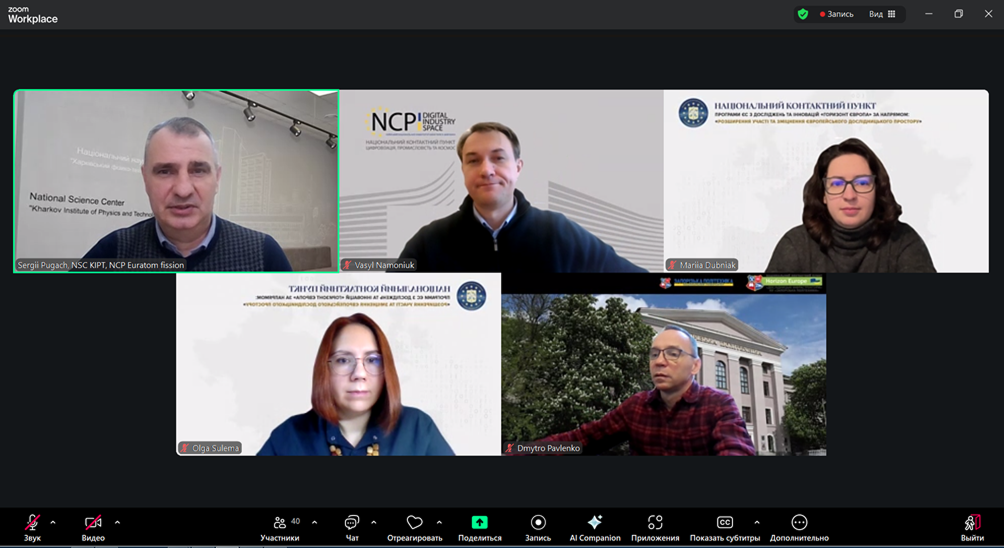
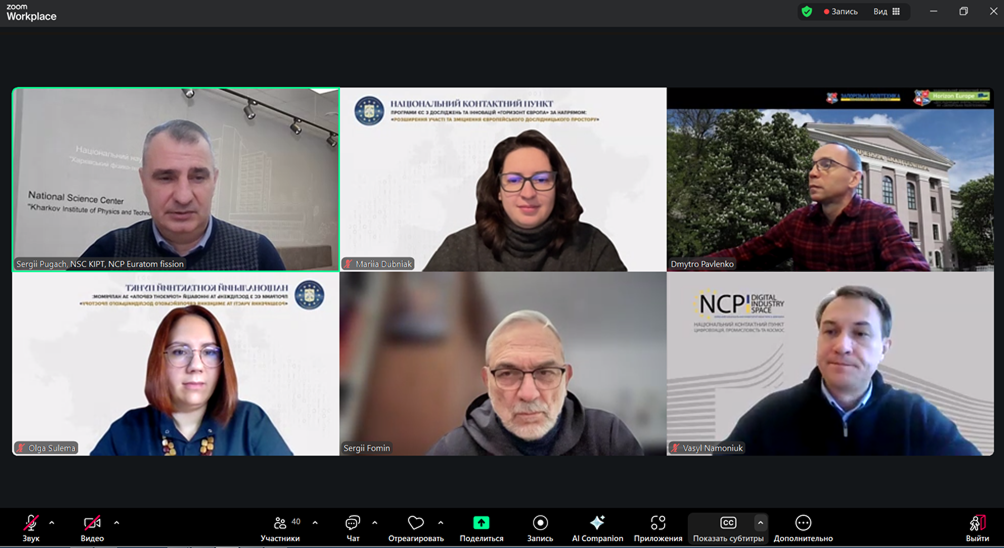
On 5 December 2025, the National Science Center “Kharkiv Institute of Physics and Technology” (NSC KIPT) and the Euratom National Contact Point in Ukraine (fission and fusion), together with the NCP “Widening Participation and Strengthening the European Research Area,” the NCP “Research Infrastructures,” and the NCP “Digital Technologies, Industry and Space,” held an Information Day dedicated to the EU Framework Programmes Horizon Europe and Euratom.
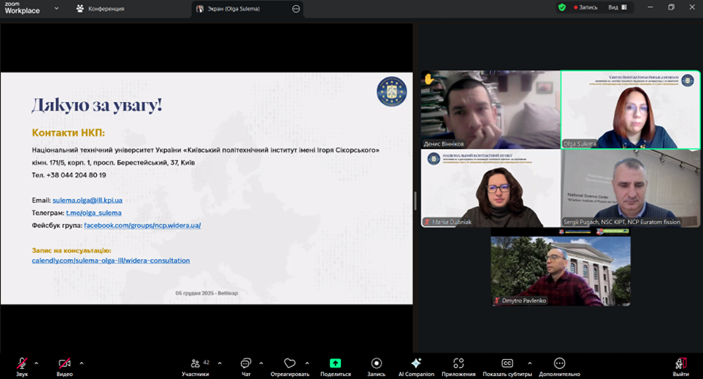
The event aimed to inform Ukrainian researchers about opportunities for participation in the 2026–2027 calls, to provide recommendations for preparing successful project proposals, and to discuss the strategic priorities of the programmes. A total of 42 representatives from research institutions and universities across various regions of Ukraine took part in the Information Day.
The Information Day was opened by Sergii Pugach, PhD in Physics and Mathematics, MBA, Head of the NCP Euratom fission (NSC KIPT).
He outlined the objectives of the event, presented the agenda, and emphasised the importance of Ukraine’s active involvement in European research initiatives, particularly in the context of strengthened cooperation in the nuclear and energy sectors.
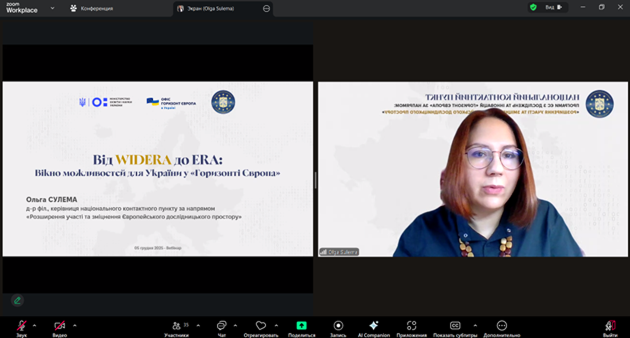
1. From WIDERA to ERA: A Window of Opportunities for Ukraine in Horizon Europe
Olga Sulema, PhD, Head of the NCP for “Widening Participation and Strengthening the European Research Area” (National Technical University of Ukraine “Igor Sikorsky Kyiv Polytechnic Institute”), presented an overview of the development of the European Research Area (ERA) and explained the role of the WIDERA destination, which covers widening participation, spreading excellence, and reforming the European research and innovation system.
She outlined the structure of WIDERA, key changes in the 2026–2027 Work Programme, Ukraine’s place within ERA, and highlighted successful examples of Ukrainian participation.
Olga Sulema stressed that Ukraine’s engagement in WIDERA continues to grow, and the new Work Programme opens additional opportunities for institutional partnerships, postdoctoral fellowships, and joining ongoing consortia.
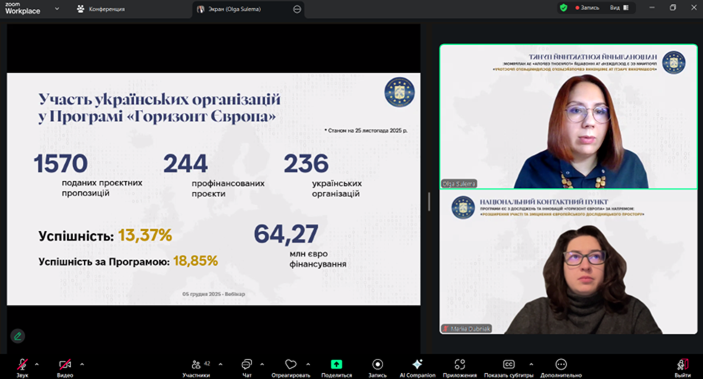
2. The WIDERA Grant Map for 2026: Where Ukrainian Researchers Should Apply
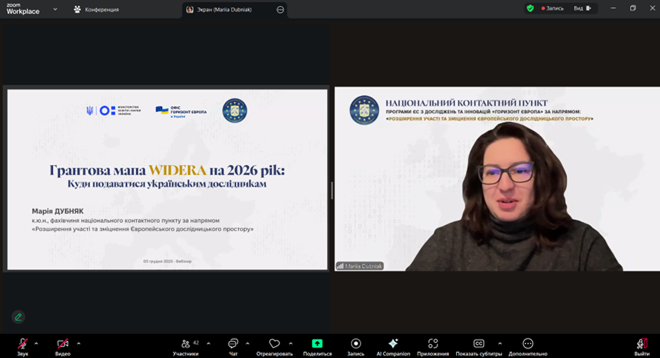
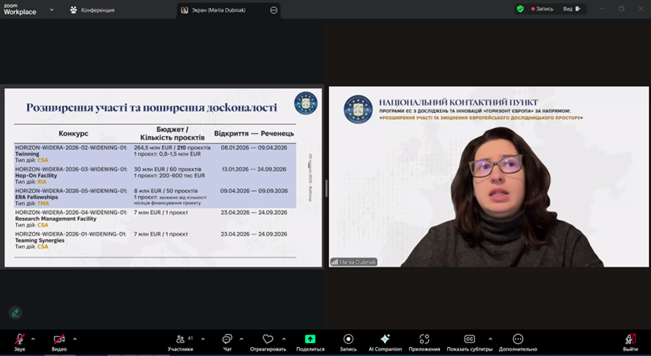
Mariia Dubniak, PhD in Law, Leading Specialist of the NCP for “Widening Participation and Strengthening the European Research Area” (NTUU “Igor Sikorsky Kyiv Polytechnic Institute”), presented a detailed overview of the WIDERA calls for 2026, including:
- institutional partnership programmes;
- widening participation and spreading excellence actions;
- opportunities for postdoctoral fellowships;
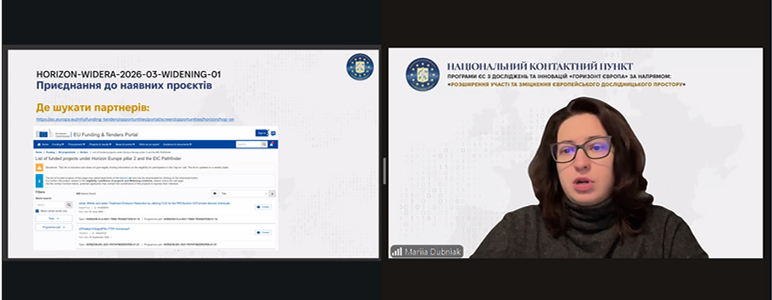
- options for joining ongoing projects.
She also provided practical recommendations on selecting calls, preparing applications, and developing a successful participation strategy.
3. Research Infrastructures: The 2026 Call Roadmap
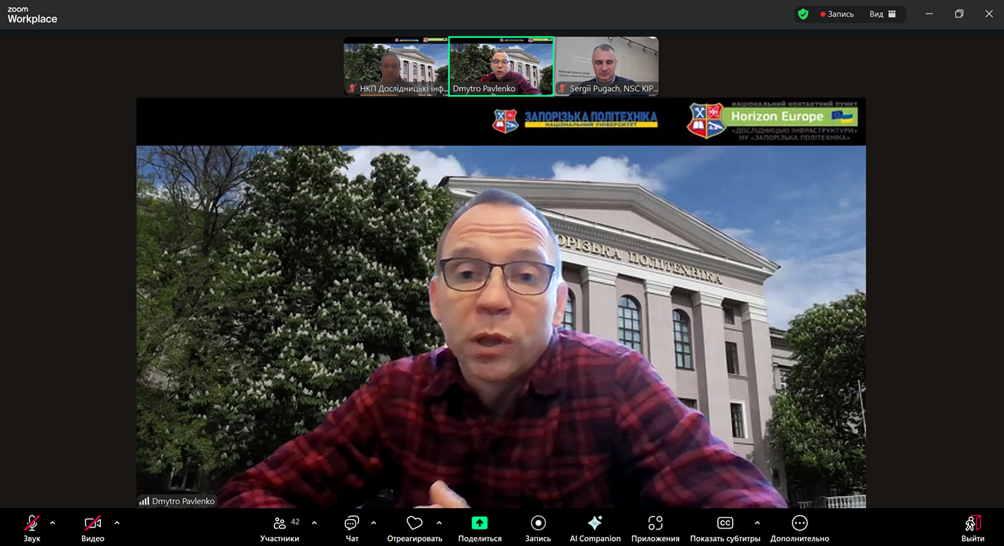
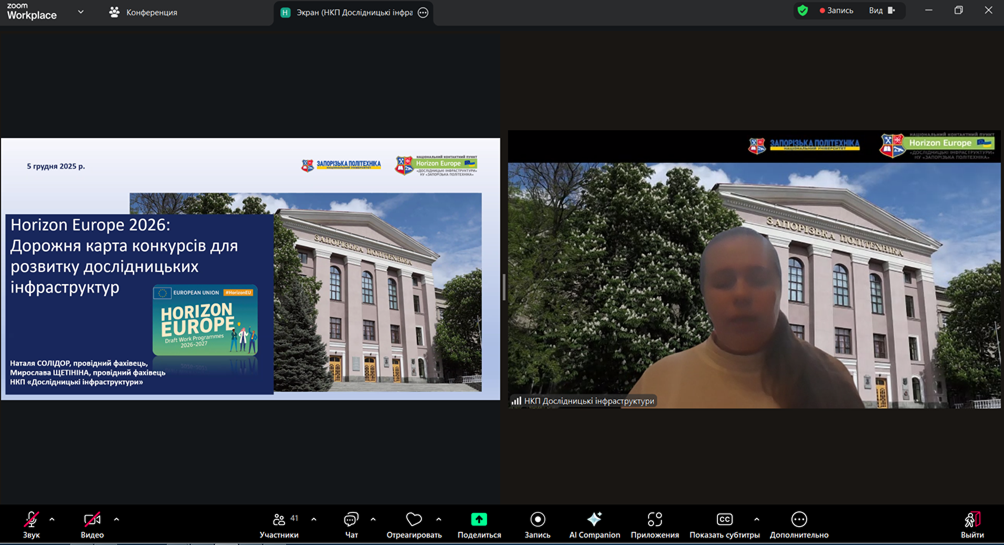
Dmytro Pavlenko, Doctor of Technical Sciences, Professor, Head of the NCP “Research Infrastructures” (National University “Zaporizhzhia Polytechnic”), presented the content of the 2026–2027 Work Programme, the available instruments for Ukrainian organisations, project types and partnership requirements.
He highlighted key aspects and specific conditions for Ukraine’s participation in the field of research infrastructures.
4. Work Programme 2026–2027 “Digital, Industry, Space”
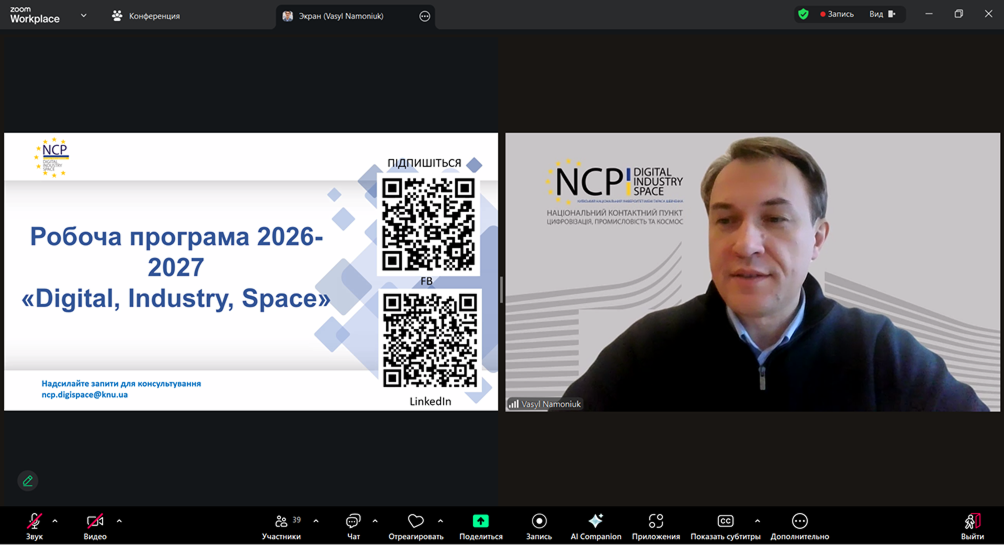
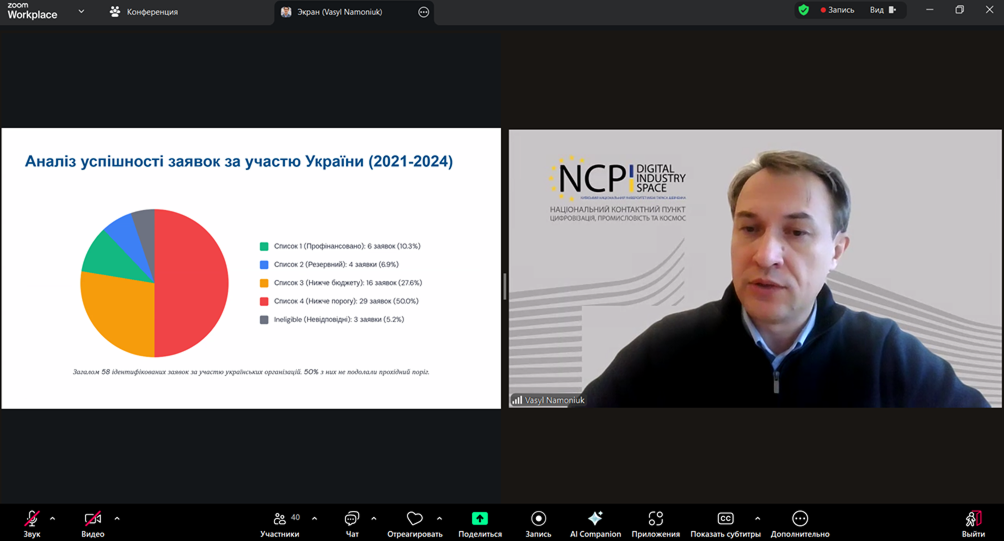
Vasyl Namoniuk, Associate Professor, Head of the Department of International Finance, EEN Expert, and NCP for “Digital Technologies, Industry and Space”, delivered a presentation on the strategic priorities of Cluster 4 of Horizon Europe and an analysis of Ukraine’s participation in 2021–2024.
He presented the main directions of the cluster — SPACE, DIGITAL-EMERGING, HUMAN-centred technologies, RESILIENCE, and TWIN-TRANSITION — along with the participation dynamics of Ukrainian teams, key success factors, reasons for rejected proposals, and recommendations on call selection and proposal preparation.
Among the main conclusions:
- Ukrainian teams demonstrated significantly increased activity in 2024, particularly in RESILIENCE and TWIN-TRANSITION;
- Ukrainian projects remain competitive, though many applications require improved quality to pass threshold scores;
- the greatest potential is observed in RIA-type projects, which consistently receive high evaluations;
- special attention should be paid to topics with third-country participation restrictions (Space, Digital Technologies).
The speaker also presented an overview of upcoming calls opening in December 2025 and January 2026, as well as the strategic priorities expected for the 2027 Work Programme.
The Information Day of Horizon Europe and Euratom demonstrated the strong and growing interest of the Ukrainian research community in participating in EU Framework Programmes.
Speakers presented concrete instruments, opportunities, and roadmaps for engaging in the 2026–2027 calls and provided practical guidance for preparing competitive proposals.
The event became an important step towards strengthening the integration of Ukrainian research institutions into the European Research Area and is expected to contribute to an increase in successful Ukrainian projects in the coming years.
Seminar materials:
Video recordings:
https://drive.google.com/file/d/1qtXAR4MoPHVm8VQzx488JHmU1-MiE_Ry/view?usp=sharing
Speaker presentations:
- Olga Sulema – From WIDERA to ERA: A Window of Opportunities for Ukraine in Horizon Europe
- Mariia Dubniak – The WIDERA Grant Map for 2026: Where Ukrainian Researchers Should Apply
- Dmytro Pavlenko – Research Infrastructures: The 2026 Call Roadmap
- Vasyl Namoniuk – Work Programme 2026–2027 “Digital, Industry, Space”


