


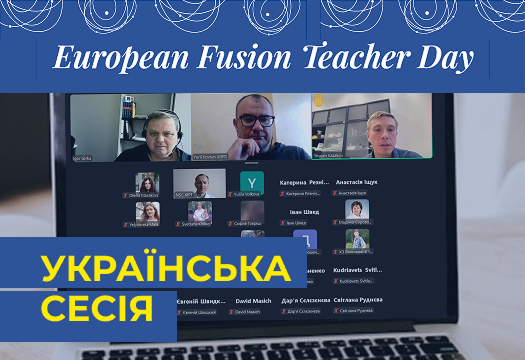

On 10 October 2025, the European Fusion Teacher Day 2025 — an annual educational online event dedicated to promoting knowledge about fusion energy — took place. The event, organised by FuseNet, is designed for science and physics teachers across Europe. Its aim is to introduce school teachers to fusion as a promising area of nuclear energy and to discuss existing educational materials that can be used to teach this topic in secondary schools.
The event featured two online sessions: a national (Ukrainian-language) session and a pan-European (English-language) session. The Ukrainian session was organised by the National Science Centre “Kharkiv Institute of Physics and Technology” (NSC KIPT), the Educational and Research Institute “School of Physics and Technology” of V.N. Karazin Kharkiv National University, the EURATOM National Contact Point in Ukraine, and the NURECAB project (Grant Agreement No. 101173510). The three-hour session consisted of lectures by fusion experts who presented current research in the field, both globally and in Ukraine. This year, the event gathered more than 30 participants from across the country.
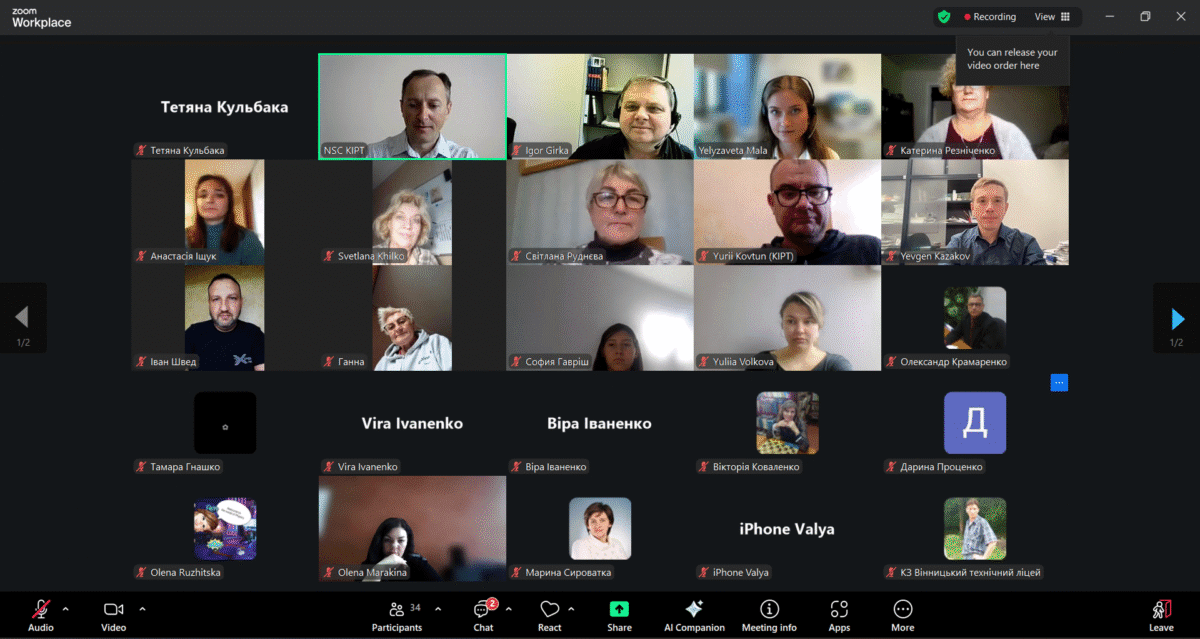

The Ukrainian session was opened by Professor Ihor Hirka, Corresponding Member of the National Academy of Sciences of Ukraine, Vice President of the Ukrainian Physical Society, and professor at the School of Physics and Technology, V.N. Karazin Kharkiv National University. In his welcome address, he emphasised the importance of advancing science education and engaging young people in fusion research.
Next, Vitalii Zhurenko, Senior Researcher at the NSC “Kharkiv Institute of Physics and Technology” and member of the EURATOM National Contact Point in Ukraine, presented the activities of the NCP and shared information about educational initiatives held within the NURECAB project for school pupils and teachers.


Yelyzaveta Mala, a PhD student at the Max Planck Institute for Intelligent Systems (NISE Department), delivered a presentation titled “From Plasma to Spintronics: a Journey through Thin Films.” She explained the methods of producing thin films using Physical Vapour Deposition (PVD), discussed their structure and magnetic properties, and described their applications in spintronics — the field that explores the use of electron spin for information transfer and storage in advanced electronic devices. She also highlighted the close collaboration between Ukrainian and German research groups.


Yevhen Kazakov, Researcher at the Laboratory for Plasma Physics, Royal Military Academy (Brussels, Belgium), spoke about the development of the European fusion programme. He discussed the operation of modern experimental fusion devices and the challenges faced by scientists on the path towards implementing fusion as a practical energy source. Special attention was paid to the ITER project, which aims to demonstrate the scientific and technological feasibility of fusion energy as the power of the future.


Yuliia Volkova, Senior Researcher at the Institute of Plasma Physics, NSC KIPT, presented a talk entitled “NSC KIPT Plasma Accelerators: the Path to New Technologies.” She described studies of plasma accelerators, plasma–material interactions, and the prospects for their application in energy and materials science.


The Ukrainian session concluded with Dr Yurii Kovtun, PhD in Physics and Mathematics and coordinator of the EURATOM – Fusion National Contact Point in Ukraine. In his talk, he outlined Ukraine’s participation in Horizon Europe and EUROfusion programmes, presented the work of the Institute of Plasma Physics, NSC KIPT, and described the research conducted on the Uragan-2M stellarator within European collaborations.


During the European session, FuseNet representatives presented free educational materials on plasma physics and fusion (five modules in total), which are currently being translated into several languages and are available in the database at https://indico.fusenet.eu/event/58/page/265-translated-modules.


It is worth noting that thanks to specialists from the School of Physics and Technology, V.N. Karazin Kharkiv National University, and the NSC KIPT, all training modules have been translated into Ukrainian and are available on the website of the EURATOM National Contact Point in Ukraine. Access to materials via the link: https://uaineuratom.com.ua/s/vplyv.
The event served as an important platform for exchanging knowledge between scientists and teachers and as another step towards promoting fusion science among young people.
Conference materials
Presentations:
- V.Zhurenko – EURATOM Program, EURATOM National Contact Point in Ukraine. Activities for schoolchildren in the NURECAB project.
- Y.Kovtun – Ukraine’s participation in the Euratom thermonuclear program
- Y.Mala – From plasma to spintronics: a journey through thin films
- Y.Kazakov – Fusion Energy and Advancing the European Fusion Roadmap
- Y.Volkova – PLASMA ACCELERATORS: THE WAY TO NEW TECHNOLOGIES
Video recordings:
The NURECAB project (GA#101173510) is funded by the European Union under the Euratom Research and Training Programme (HORIZON EUROPE).
The views and opinions expressed are those of the author(s) only and do not necessarily reflect those of the European Union or the European Commission. Neither the European Union nor the European Commission can be held responsible for them.


