


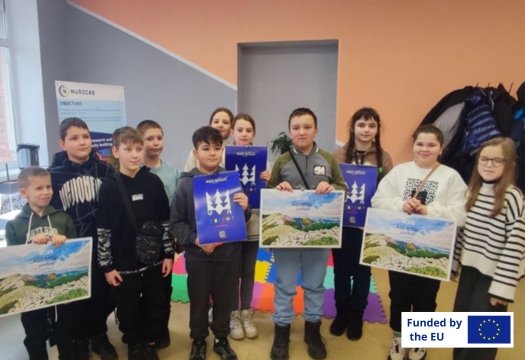
In January and February 2025, a series of events were organized within the European project NURECAB (Euratom, Horizon Europe, GA#101173510) to promote science and introduce school students to the prospects of nuclear education. Lectures, excursions, and interactive demonstrations allowed future students to immerse themselves in the world of physics and nuclear energy while learning about professional development opportunities in the field.
- The first event occurred on January 5, 2025, at «Pokotylivka Lyceum «Promin». A popular science lecture, “Physics in Cinema,” was held for 17 students in grades 8–10, organized by the Departments of Micro- and Nanoelectronics and Physics of Metals and Semiconductors of NTU “KhPI”.Participants not only learned about physical phenomena in cinematography but also conducted experiments in optics, mechanics, and electromagnetism. A special highlight was the discussion on the scientific accuracy of scenes from popular Marvel films. The event sparked students’ interest in modern technologies, and teachers noted its practical value.
- On February 3, 2025, a similar event was held at Boiko School, where 75 pupils from grades 8 and 10 participated. In addition to traditional demonstration experiments, students watched video clips from iconic films and, together with scientists, analyzed which scenes were based on real physical laws and which were purely artistic fiction. The interactive format encouraged active student engagement in discussions and helped develop their interest in the exact sciences.
- On February 10 and 17, 2025, the Department of Nuclear Physics and High Energy Physics of Taras Shevchenko National University of Kyiv hosted 28 students from the private “Nova Shkola” and Kyiv Lyceum № 252. During the excursion, students learned about the operation of modern laboratory equipment used in radiation monitoring and nuclear research. University professors provided detailed explanations of the principles behind detectors and measurement systems, allowing students to see science in action. Additionally, special attention was given to the opportunities provided by the NURECAB project, from participation in educational programs to internships at leading research centers.


The conducted events demonstrated the high level of interest among young people in science, particularly in physics and nuclear energy. The interactive format of lectures, excursions, and discussions contributed to a better understanding of complex scientific concepts and their practical applications. The active participation of students and lively discussions confirmed the importance of such initiatives in developing the country’s scientific potential and guiding future students in their career choices.


The events were supported by the NURECAB project (Euratom, Horizon Europe, GA#101173510).
This project has received funding from the European Union under the EURATOM 2023–2025 work program, GA#101173510.
However, the views and opinions expressed are solely those of the author(s) and do not necessarily reflect the position of the European Union or the European Commission.
Neither the European Union nor the European Commission is responsible for these statements.


